Home · Costs & Insurance
San Marcos water restoration pricing, from the terrain outward
What does water restoration cost in San Marcos, and which policy answers for it?
Published guides place a typical home water restoration between $1,200 and $5,500, and San Marcos distributes its homes inside that band by terrain and run time: a heater leak caught in a day in Twin Oaks is the band's low end, while storm water across a creek-side ground floor, cleaned as contaminated and dried against a slab, is its top. The policy answer follows the water's origin with unusual strictness. Failures inside the system, lines, heaters, hoses, are the standard sudden-damage claim. Water that traveled over ground to reach the house is an outside event, excluded by standard policies and answered, if at all, by flood coverage. That is why the assessment documents origin before it prices anything: the origin decides both the cleaning protocol and the claim, and it can only be documented once, at the start.
A San Marcos estimate opens with a question no invoice line shows: which terrain is the house on? Hillside master-planned lots in San Elijo and Discovery Hills, the creek-side old core, and the Twin Oaks valley floor dry differently, access differently, and fail differently, and the price follows those facts through the published band for a typical home restoration, $1,200 to $5,500. Inside the band, the movers are run time, how long water moved before the shutoff, assembly count, and whether drying fights a slab that keeps wicking at its edges. The written scope names the terrain finding beside the total, so the number can be defended to an adjuster or a spouse with the same sentence.
Compiled from published national guides and local data; reviewed by the Twin Oaks Restoration research team. Last reviewed November 16, 2026.
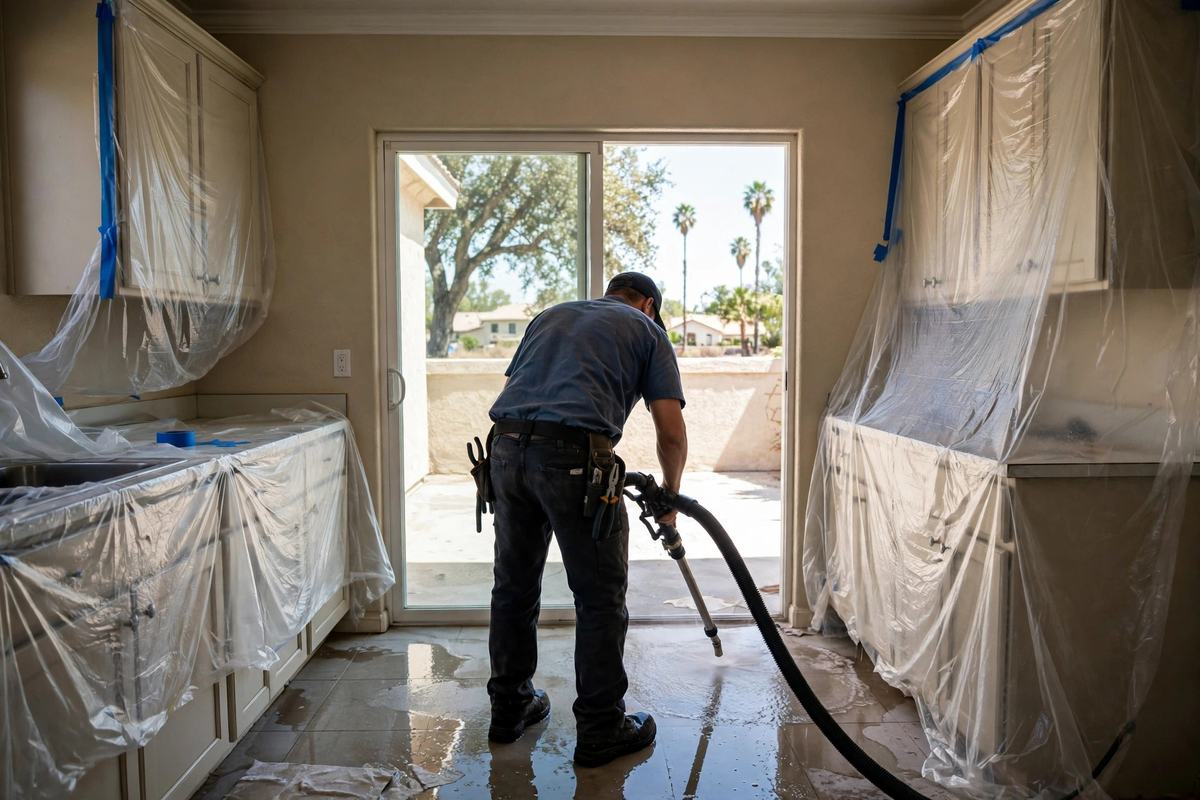
Typical cost ranges
| Job | Typical range | What moves it |
|---|---|---|
| Stopping the loss: shutoff, extraction, first documentation | $500 to $1,500 | Priced as the response visit; includes the source photographs every later document depends on. |
| Drying a slab home to standard | Set by the first day's readings, confirmed daily | Wall-base meters decide the equipment days; hillside lower levels are read as their own zone. |
| Cleaning a storm or creek entry | $1,500 to $5,500 | Water that crossed ground is handled as contaminated from step one, with entry lines recorded before work. |
| Sewage event remediation | Scoped by the rooms and assemblies reached | Containment first, porous material out, and the floor assemblies metered, not assumed. |
| Heater and appliance leak cleanup | $1,200 to $4,000 | The quiet class: assemblies around the closet and across the slab read in three directions from the source. |
Guide ranges only. Your binding figure is the written scope from the assessment, with terrain and first readings stated on it.
How insurance pays for this work
The deductible question
San Marcos claims turn on a distinction the first photographs settle: a failure inside the plumbing system, which standard policies treat as sudden damage, versus water that arrived overland, at a door, a garage seam, off a graded lot, which they treat as an outside event. Creek-side and low-core homes should hear the flood policy question asked during this claim, not after the next storm; the assessment's entry documentation is what makes either argument possible.
Request a callback
Prefer to talk later? Leave your details and an independent local pro will call you back. No charge to you, no obligation.
Twin Oaks Restoration is a free referral service. Submitting this form connects you with independent local contractors who provide the work.